As the saying goes, despite “the best plan of mice and men”, yachts frequently have a tendency to unearth the unknown.
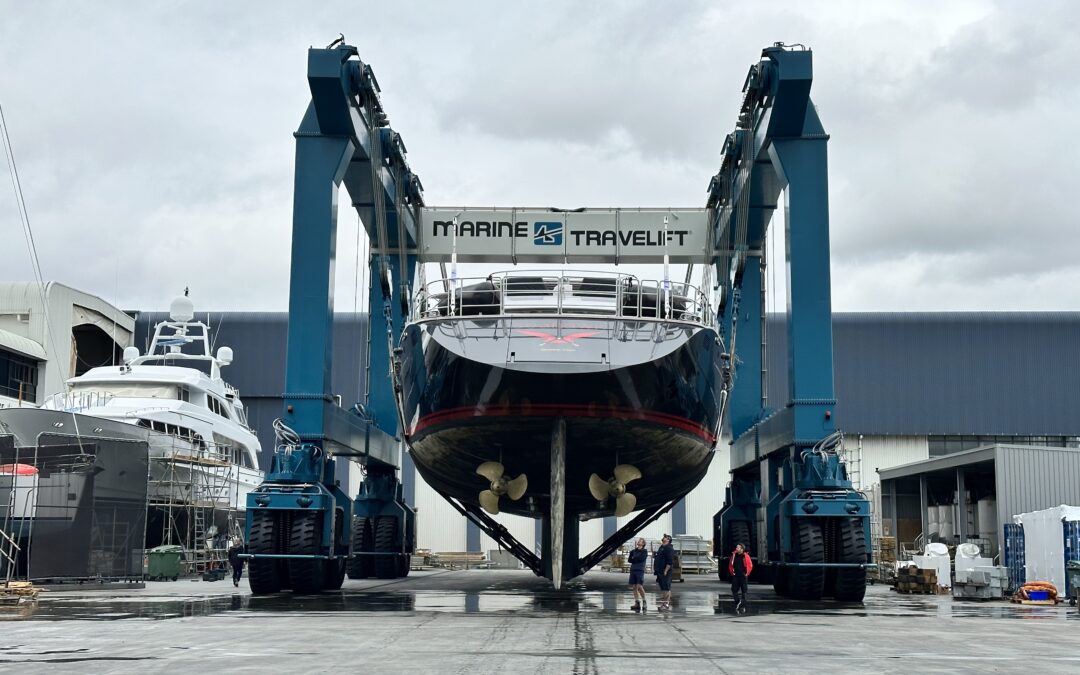
With Seahawk hauled out and safely choked on the hard, the next step was the disassembly of the boat for the painters, as well as the opening of sealed spaces and closed machinery for inspection by the ABS surveyor.
The process of a refit is often a voyage of discovery, and it can generate a range of new issues previously hidden from view. While experience is valuable in pre-empting these additional tasks, there’s sometimes the risk of finding new surprises.
Seahawk followed this mantra and gave us a few curved balls. The most significant one was the need to replace both stern tubes of the boat. These are pipes that run between the aft wall of the engine room to the hull, with the propellor shaft spinning inside it. These tubes are constantly full of seawater, which is highly destructive. This area of the boat is prone to gradual corrosion failure. In Seahawk’s case, there had been a rapid corrosion process taking place since some stainless steel sleeves had been fitted into the tubes at some stage for an unknown reason.
This presented a major new project for the yard with several hurdles, starting with the acquisition of the specific grade of aluminium required, and its paper trail of material approval for ABS. As it turns out, 5083-grade aluminium in 300mm thickness is a rare beast. We scoured the world to find enough for the job. Eventually, a dealer in Holland had some that could be acceptable.
The other major hurdle to this job was accessing the area for work; the boat’s main electrical distribution panel is directly above the starboard side stern tube, meaning that the vessel would have to go dead ship for the duration of the work, and the hundreds of cables meticulously disconnected and then reconnected following the extensive welding work that would be required; this electrical job represented more labor time than the metalwork itself.
Unfortunately, a job like this comes with penalties beyond just the unexpected costs associated with the extra work; Carrying out welding work on the hull must be in accordance with fire safety requirements, and it’s, of course, messy. Performing paintwork on the boat requires the use of solvents that are explosive, as well as clean room conditions, creating a major conflict between these two tasks, making scheduling a real headache for the management team, and inevitably delaying the completion of the overall project.